
You turn the key and nothing happens. Or the engine cranks but refuses to fire. A truck that won’t start can cost you hundreds per hour in lost revenue, missed loads, and towing fees. The good news: most no-start conditions come down to seven common causes, and many of them can be diagnosed on the spot. The most frequent culprits are dead batteries, fuel delivery problems, and faulty starters. This guide covers each cause, what to check first, and when to call a mechanic.
7 Reasons Your Truck Won’t Start: Quick Reference
| # | Cause | Key Symptom | Typical Repair Cost |
|---|---|---|---|
| 1 | Dead or weak batteries | Slow crank or no crank, dim lights | $150 to $350 per battery |
| 2 | Fuel system issues | Cranks but won’t fire, sputtering | $100 to $1,500+ |
| 3 | Starter motor failure | Single click, no crank | $400 to $900 |
| 4 | Glow plug / intake heater failure | Cranks but won’t fire (cold weather) | $50 to $150 per plug + labor |
| 5 | Low air system pressure | Gauges below 60 PSI, air leak sounds | $200 to $1,000+ |
| 6 | Electrical / sensor faults | Warning lights, fault codes on dash | $100 to $200/hr diagnostics |
| 7 | Fuel shutoff / anti-theft system | No click from solenoid, wrong key | $100 to $500 |
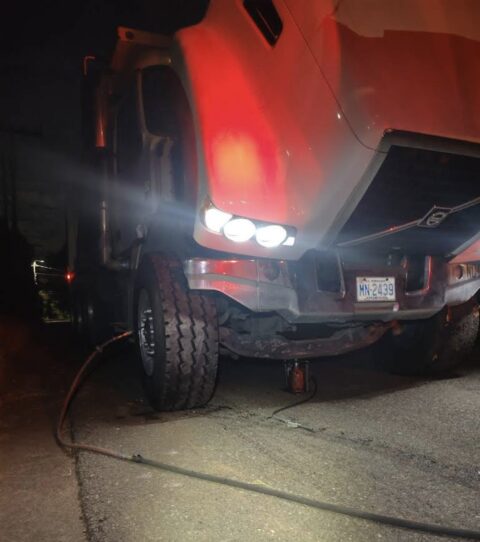
1. The number one reason a truck won't start is dead batteries
This is the number one reason a truck won’t start, especially in cold weather. Semi trucks run on two or four 12V batteries wired in series. If even one battery is weak, the system can’t deliver enough amperage to crank a diesel engine.
What to check:
- Battery terminals for corrosion (white or green buildup)
- Loose or damaged cables
- Voltage with a multimeter (should read 12.6V or higher per battery)
What to do: Clean terminals with a wire brush. If voltage is below 12.2V, the battery needs charging or replacement. Jump starting works as a temporary fix, but don’t drive on a failing battery. Replacement cost: $150 to $350 per battery.
2. If your truck won't start but cranks normally, check fuel delivery first
Diesel engines need clean fuel delivered at high pressure. Air in the fuel lines, a clogged fuel filter, or contaminated fuel (water in diesel) will prevent the engine from starting.
What to check:
- Fuel level (gauges can be inaccurate)
- Fuel filter condition and last replacement date
- Water separator indicator light
What to do: Replace the fuel filter if it’s overdue. Bleed air from the fuel system using the priming pump. If you suspect water contamination, drain the water separator. In cold weather, gelled fuel is common. Use a fuel additive rated for winter diesel or an electric fuel heater.
3. Starter Motor Failure
f you hear a single click (or nothing at all) when turning the key, the starter motor or solenoid may be faulty. Starters on heavy duty trucks take a beating and typically last 150,000 to 300,000 miles.
What to check:
- Listen for clicking sounds when turning the key
- Check battery voltage first (rule out weak batteries)
- Inspect starter wiring for loose connections
What to do: Tapping the starter housing with a wrench can sometimes free a stuck solenoid as a temporary fix. If the starter fails repeatedly, replacement is the only real solution. Starter replacement cost: $400 to $900 including labor.
4. Glow Plug or Intake Heater Problems
Diesel engines don’t use spark plugs. They rely on glow plugs or intake air heaters to warm the combustion chamber for ignition, especially below 40°F. If these fail, the engine cranks but won’t fire.
What to check:
- Wait for the glow plug indicator light to cycle off before cranking
- If the light doesn’t come on at all, the relay or controller may be bad
- Test individual glow plugs with a multimeter (resistance should be 0.5 to 2 ohms)
What to do: Replace failed glow plugs. On most trucks, this is a 1 to 2 hour job per bank. Replacement cost: $50 to $150 per plug plus labor.
5. Air System Pressure Too Low
Sometimes a truck won’t start because the air system pressure is too low to release the safety interlock. Many heavy duty trucks have air-actuated safety interlocks. If the air system pressure drops below a safe threshold (typically 60 PSI), the truck may not allow the engine to start or engage the starter.
What to check:
- Dash air pressure gauges
- Listen for air leaks around brake chambers and lines
- Check the air dryer for proper function
What to do: Locate and repair air leaks. If the compressor isn’t building pressure, it may need a rebuild or replacement. Don’t bypass air interlocks as this creates a serious safety hazard.
FMCSA requires all CMVs to pass periodic inspections per 49 CFR Part 396.
6. Electrical and Sensor Faults
Modern trucks rely on the ECM (engine control module) to manage starting. A faulty crank position sensor, cam sensor, or ECM fault code can prevent the engine from starting entirely.
What to check:
- Dashboard warning lights and fault codes
- Key switch and ignition relay
- Wiring harness connections at the ECM
What to do: Pull diagnostic codes with a scan tool. Common codes that cause no-start conditions include crank/cam sensor failures and fuel rail pressure sensor faults. This typically requires a qualified diesel mechanic with diagnostic equipment.
7. Fuel Shutoff Solenoid or Anti-Theft System
Some trucks have a fuel shutoff solenoid that closes when the ignition is off. If it sticks closed, fuel can’t reach the engine. Anti-theft immobilizers can also block starting if the key chip isn’t recognized.
What to check:
- Listen for a click from the fuel shutoff solenoid when turning the key to ON
- Verify the correct key is being used (chipped keys)
- Check for aftermarket alarm systems that may be malfunctioning
What to do: Test the solenoid with a multimeter or apply 12V directly to check operation. If the immobilizer is the issue, try the spare key. Dealer reprogramming may be needed.
Quick Diagnostic Checklist
- 1 Turn the key to ON (don’t crank). Do dashboard lights come on?
- 2 Check battery voltage. Is it 12.6V or higher per battery?
- 3 Wait for the glow plug light to cycle off. Does it illuminate?
- 4 Try to crank. Does the engine turn over?
- 5 If it cranks but won’t fire: check fuel level, fuel filter, and fuel lines for air.
- 6 If it clicks but won’t crank: check starter, battery cables, and connections.
- 7 If nothing happens at all: check key switch, fuses, and main power relay.
- 8 Check air pressure gauges. Is system pressure above 60 PSI?
- 9 Pull diagnostic codes if available. Look for sensor or ECM faults.
- 10 If all checks pass and the truck still won’t start: call a diesel mechanic.
Truck Won’t Start: Cranks vs. Doesn’t Crank
| Symptom | Most Likely Causes | Check First |
|---|---|---|
| Engine cranks but won’t fire | Fuel delivery, glow plugs, fuel shutoff solenoid | Fuel filter, fuel level, glow plug indicator |
| Single click, no crank | Starter motor, solenoid, battery connections | Battery voltage, cable tightness, starter wiring |
| Slow/weak crank | Weak batteries, corroded terminals, cold weather | Battery voltage, terminal condition |
| Nothing at all (no lights, no sound) | Dead batteries, blown fuse, bad key switch, kill switch | Battery disconnect, main fuse, ignition relay |
| Cranks, fires briefly, then dies | Fuel starvation, air in lines, clogged filter | Fuel pressure, prime the system, water separator |
FAQ
What is the most common reason a truck won’t start? Dead or weak batteries account for roughly 40% of no-start calls. This is especially true in winter when cold temperatures reduce battery capacity by up to 50%.
My truck cranks but won’t start. What should I check first? Start with the fuel system. Check fuel level, fuel filter, and water separator. Then verify that glow plugs or the intake heater are functioning. These two areas cover the majority of “cranks but no start” situations.
Can cold weather cause a diesel truck not to start? Yes. Cold weather is a common reason a truck won’t start in winter. Cold weather thickens diesel fuel (gelling), weakens batteries, and makes the combustion chamber harder to heat. Use winter blend fuel, keep batteries charged, and make sure glow plugs are working before the cold season.
How much does it cost to fix a truck that won’t start? It depends on the cause. A battery replacement runs $150 to $350 per unit. A starter replacement costs $400 to $900. Fuel system repairs range from $100 (filter change) to $1,500+ (injector pump). Electrical diagnostics start at $100 to $200 per hour.
Should I jump start my semi truck? You can, but use the correct procedure. Connect jumper cables to matching battery banks (positive to positive, negative to ground). Never jump a 12V system from a 24V source or vice versa. If you need frequent jump starts, your batteries or charging system need attention.
How long can a diesel truck sit before it won’t start? A truck in good condition with charged batteries can sit for 2 to 4 weeks without issues. Beyond that, batteries may drain, fuel can degrade, and condensation can form in the fuel tank. If storing longer, use a battery maintainer and a fuel stabilizer.
When your truck won’t start, work through the problem systematically. Start with the batteries, then check fuel delivery, the starter, and glow plugs. Most no-start issues fall into one of these categories and can be resolved quickly by an experienced diesel mechanic. Stuck with a truck that won’t start in the Monroe or Charlotte, NC area? Call G Smart Service LLC at (980) 318-0425 for mobile diagnostics and repair. We come to you.
Learn more about our truck repair services in Monroe, NC.